

Keep Your Dust to Yourself: Michigan Senate Takes Up Fugitive Dust Bill
Oko Environmental traveled to Lansing on September 22 to attend a hearing of the Michigan Senate Natural Resources and Agriculture Committee on Senate Bill 1038, legislation aimed at reducing fugitive dust from facilities that store, handle, process and transport bulk solid materials. This bill was brought to my attention by aggregate mining expert and geologist Mike Wilczynski of Pangea Environmental LLC.
- Click to view notice for September 22, 2026 Michigan Senate Natural Resources and Agriculture Committee meeting
- Click to view Senate Bill 1038 [Fugitive Dust Amendment to Natural Resources and Environmental Protection Act]
SB 1038 was introduced by Sen. Erika Geiss and co-sponsored by Sens. Stephanie Chang, Sue Shink and Jeff Irwin. It was referred to the Senate Natural Resources and Agriculture Committee, chaired by Shink.
NOTE: The bill defines “bulk solid material” as material that can be used as fuel or as an ingredient in a manufacturing process and may become airborne or scattered by wind. It specifically mentions ores, coal and coke1 and excludes salt and grain. Sand, gravel and crushed stone are not specifically named.
From Seeing Dust To Measuring It
Michigan’s existing air-quality framework includes visible-emission standards that measure fugitive dust through opacity, so how much a dust plume blocks light or obscures the background when you look at it. EGLE guidance describes visual observation methods used for fugitive dust from sources including roads and bulk-material storage areas.
SB 1038 would add a different, more proactive & scientific approach for facilities including permanent, continuous, real-time PM10 monitoring around the property perimeter.
In the Bill:
During the first year, at least four PM10 monitors would be placed around the facility, with one facing each cardinal direction: north, south, east and west. Data collected during that first year would then be used to guide the monitoring plan for subsequent years, helping determine where fugitive dust is traveling and where monitoring is most needed. Beginning in the second year, the system would include two upwind and two downwind monitors, with additional monitors added as appropriate based on factors such as facility size, variability in wind direction and proximity to residential neighborhoods. The facility would also be required to install a weather station, or similar permanent device, to monitor and log wind speed and direction.
The bill also includes physical dust controls such as an 8 mph on-site speed limit, cleaning loose material from outgoing trucks, wheel washes or rumble strips, covered truck beds, controls at conveyors and transfer points, and wet sweeping of paved roads on-site and for at least one-quarter mile outside the property.
Fugitive dust regulation, explained by every mom ever:
Keep your mess to yourself.
The basic concept can be summarized pretty simply: what happens on your property should stay on your property. During the hearing, Shink asked Geiss whether the facilities being discussed were generally for-profit corporations. Geiss responded yes. Shink then noted that nearby residents can experience “external costs” resulting from those operations, which Geiss also acknowledged.
Andrew Bashi, an attorney with the Great Lakes Environmental Law Center, testified at the hearing describing the legislation as “a good start” to the fugitive dust issue.
Bashi is also familiar with the Ormond Road mining proposal. In June 2025, the Great Lakes Environmental Law Center submitted a public comment letter to Springfield Township citing nearly 100 environmental violations at Levy and affiliated Michigan facilities, including repeated air-quality violations involving monitoring, emissions, operational restrictions, and interference with the comfortable enjoyment of life and property.
Recognizing The Dust We Cannot See
The move toward particulate matter (PM) monitoring is significant for another reason: not all potentially harmful dust is visible.
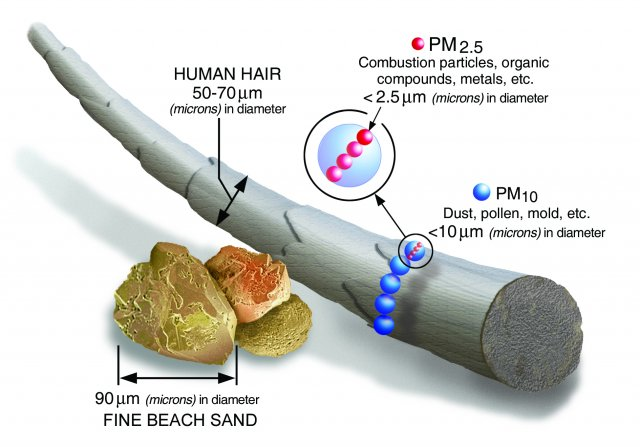
EPA explains that particulate matter includes microscopic solids and droplets that can be inhaled. Particles smaller than 10 micrometers can reach deep into the lungs, and some may enter the bloodstream. EPA identifies PM2.5 (particles 2.5 micrometers or smaller) as the fine-particle fraction associated with the greatest health risk.2
In that sense, SB 1038 begins to move beyond regulating only what can be seen with the naked eye. Potentially harmful airborne material can be present even when residents cannot see a visible cloud of dust.
Important Note: Currently, the bill specifically requires continuous PM10 monitoring. It does not require a separate PM2.5 monitoring system. PM2.5 particles fall within the broader PM10 size range, but a PM10 measurement does not separately tell us how much of the measured particulate is PM2.5.
Why Springfield Township Residents Should Notice
SB 1038 is not written specifically as an aggregate-mining bill, but many of the activities it addresses are also common at sand-and-gravel operations: stockpiling, processing, conveyors, truck loading, internal haul roads and transportation. As Springfield Township residents know all too well by now, Levy is proposing their 3rd aggregate mining site in Springfield Township.
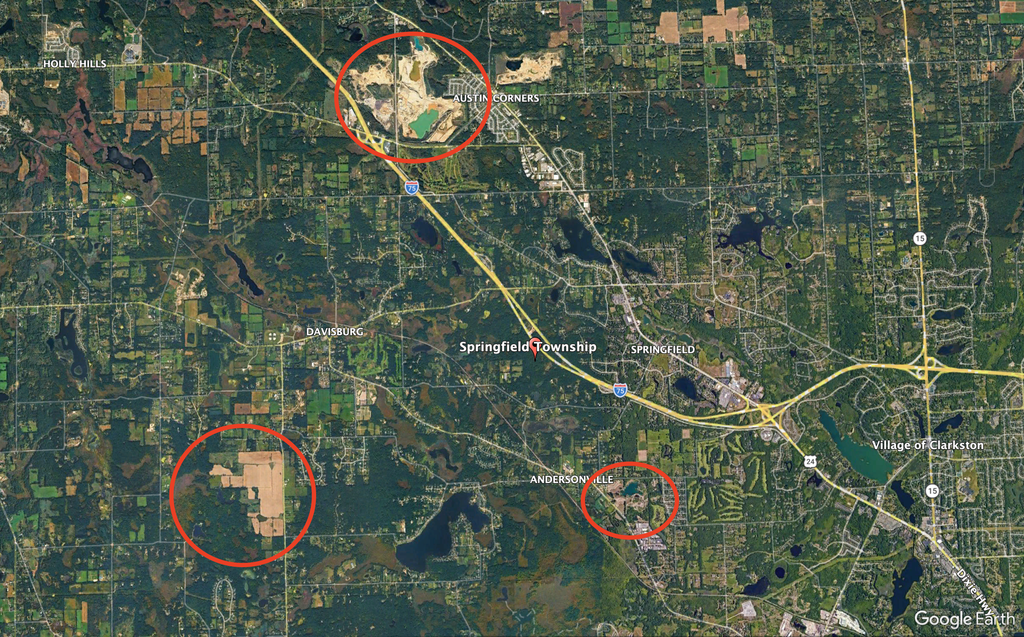
This newest mining proposal identifies a 213-acre site off Ormond Road3. It states that sand and gravel would be extracted using front-end loaders, with material either loaded directly into trucks or placed into the feed hopper of a processing plant.
The submitted plan’s dust-control provisions are largely centered on the roads, requiring access roads to be treated with chloride, water or similar dust-retardant materials. However, the plan does not appear to include specific fugitive-dust protections for nearby homeowners from other parts of the operation, including stockpiles, processing, material transfer and truck loading. Nor does it establish continuous perimeter particulate monitoring that could quantify how much dust leaves the property, under what conditions, or how far it could travel.
SB 1038 would introduce something different: continuous monitoring of particulate conditions around the perimeter of covered facilities. For residents who already live near the large, active Holly Sand and Gravel operation, that could provide a long-needed layer of protection and air-quality data that has not been available during the mine’s more than half-century of operation.
Ormond Road Primary Product = 2NS Sand
Although the Ormond Road proposal is routinely referred to as a gravel pit, Levy has specifically stated that the primary product expected from the property is 2NS sand. That distinction is relevant when talking about airborne particulate. Sand can generate particles in many different sizes. Some are large enough to see. Others are microscopic.
There is also a separate question of what those particles are made of. Crystalline silica, commonly occurring as quartz, is naturally present in many mined materials, including stone, sand and gravel. NIOSH notes that respirable crystalline silica can become airborne during mining activities such as crushing, grinding, hauling and material transfer.4
At this point, residents have not been provided with a mineral composition of the proposed Ormond Road sand that would show exactly how much crystalline silica is present in the deposit. That amount can vary considerably depending on the geology and source material. For context, safety data for some natural sand-and-gravel products list quartz concentrations ranging from about 10% to 90%. Separately, a NIOSH/MSHA study of 17,007 respirable-dust samples from surface construction sand-and-gravel mines found a geometric mean silica content of 9.7% in the respirable dust analyzed5. Neither figure establishes the silica content of the Ormond Road material; site-specific testing would be needed to determine that.
This illustrates an important distinction between particle size and particle composition. PM monitoring tells us how much particulate matter within a certain size range is present in the air. It does not, by itself, tell us what those particles are made of. Testing specifically for crystalline silica requires separate sampling and laboratory analysis6.
SB 1038 would require continuous PM10 monitoring, but it does not separately require PM2.5 monitoring or analysis of airborne particulate for crystalline silica.
A More Preventative Approach
For Oko Environmental, one of the most notable aspects of SB 1038 is the shift from relying largely on what can be observed after dust becomes visible to continuously collecting information about particulate matter at a facility boundary.
The bill would also require annual operating certificates, fugitive-dust plans, weather monitoring and specific controls for material storage, handling and transportation. Facilities would have to notify EGLE when monitoring reaches the bill’s defined reportable action level or when monitoring equipment malfunctions.
Visible dust and resident complaints can document that something has already happened. Continuous monitoring has the potential to provide a record of conditions while an operation is underway — including particles that residents may never be able to see.
For communities like Springfield Township near extensive aggregate operations for decades, SB 1038 would represent a significant shift in approach. It does not address every air-quality concern, but rather than placing the burden on nearby residents to prove that dust is leaving a facility, it would use science and technology to continuously measure what is actually happening at the property line so those who are profiting from the property do not make a mess in the community.

- Not the soda. Not the drug. Coke is a carbon-rich material used heavily in iron and steelmaking, where it serves as both a fuel and part of the chemical process that turns iron ore into iron. Yeah – I didn’t know that either. Here is more information. ↩︎
- EPA Particulate Matter (PM) Basics ↩︎
- Ormond Road Mining Proposal ↩︎
- Hazardous Exposures to Silica in Metal and Nonmetal Mining Indicate the Need for Better Prevention (December 22, 2023) ↩︎
- Occupational exposure to respirable crystalline silica among US metal and nonmetal miners, 2000–2019 ↩︎
- Silica: Exposure Assessment ↩︎
